Public healthcare officials will never ask you to transfer money or disclose bank log-in details over a phone call.
Call the 24/7 ScamShield Helpline at 1799 to check if you are unsure if something is a scam or visit ScamShield for more information.
Residency
About Residency
Postgraduate medical education in Singapore has progressively adopted the new Residency system since 2010. Residency brings along significant enhancements to the postgraduate training system, with an increased emphasis on structured and formative training. Some of the components include:
- System: Institutional structures that accord resources for training and education;
- Curricula: Planned learning experiences with well-defined curricula for trainees to develop core competencies, enabling them to take on progressive graded responsibilities;
- Assessment: Regular formative assessments to ensure trainees achieve core competencies at each stage of learning;
- People: Designated core faculty with protected time to plan curricula, guide and supervise trainees and perform formative assessments.
Sponsoring Institutions
Sponsoring Institutions (SI) are groups of hospitals that offer the various Residency training programmes. Presently there are three sponsoring Institutions – NHG Health, National University Health System (NUHS) and Singapore Health Services (SingHealth) . Click on the respective SI logos for details on the specific Residency programmes offered by each SI.


Residency pathways
Medical specialties pathway
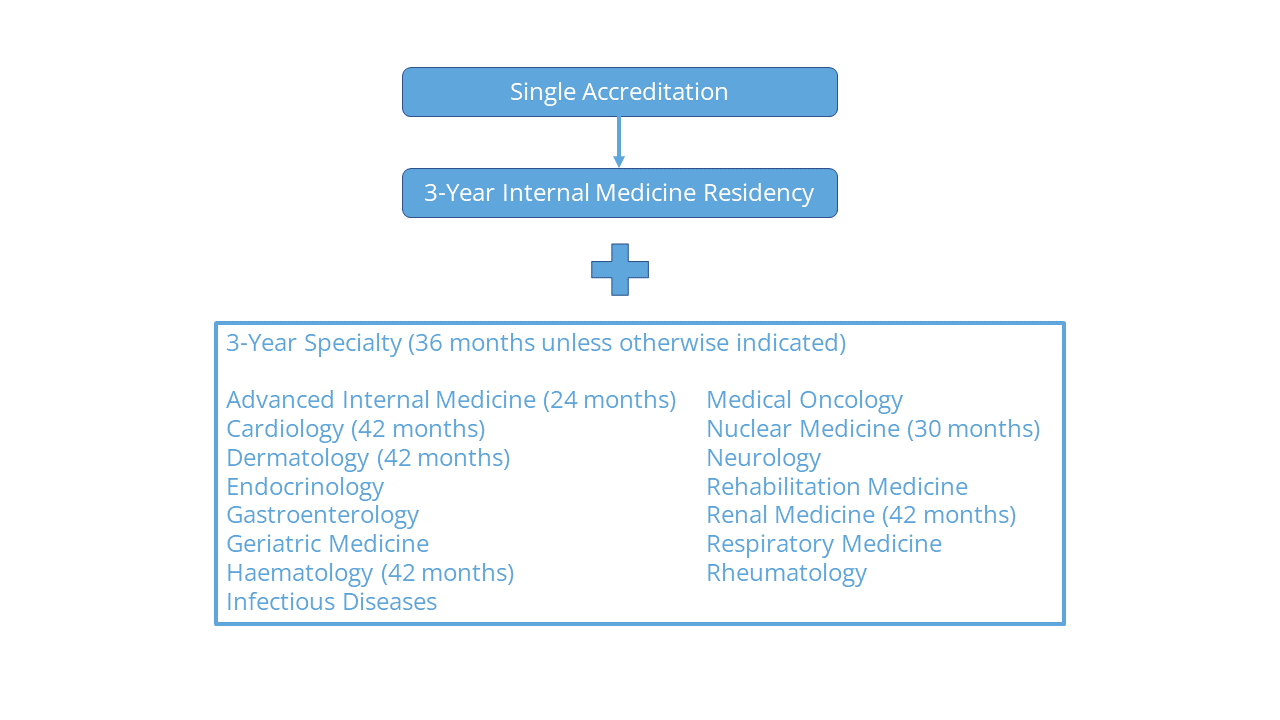
Those who are accepted into Internal Medicine (IM) Residency will be required to undergo non-specific general medicine training for three years.
At the end of their common IM training, they will enter training into Advanced Internal Medicine or one of the Internal Medicine-related specialties.
Surgical specialties pathway
Postgraduate Year 1 (PGY1) Officers and Medical Officers are eligible to apply for:
- General Surgery
- Cardiothoracic Surgery
- Hand Surgery
- Neurosurgery
- Obstetrics & Gynaecology
- Ophthalmology
- Orthopaedic Surgery
- Otorhinolaryngology
- Paediatric Surgery
- Plastic Surgery
- Urology
Other specialties/disciplines pathway
Postgraduate Year 1 (PGY1) Officers and Medical Officers are eligible to apply for training programmes in the following specialties/disciplines:
- Anaesthesiology
- Diagnostic Radiology
- Emergency Medicine
- Family Medicine
- Paediatric Medicine
- Pathology (Chemical)
- Pathology (Forensic)
- Pathology (Histopathology)
- Pathology (Microbiology)
- Preventive Medicine
- Psychiatry
- Radiation Oncology
Clinician Scientist pathway
These Residency pathways are under the purview of the Specialists Accreditation Board (SAB) Research Committee. Please visit the SAB website for requirements.
Specialties with co-payment
A co-payment is levied on residents in highly subscribed specialties. For more information on the list of specialties and the payment amounts, please refer to the SAB website.
Application process
The chart below shows the application and matching process to enter Residency training.
Application:

July 2026 Senior Residency Match Results
July 2026 Junior Residency Match Results
July 2026 Senior Residency Application Guide
July 2026 Junior Residency Application Guide
International Medical Graduates (IMGs)
Passing postgraduate exams alone without undergoing a formal structured or accredited training programme does not indicate that competency milestones in training have been reliably reached. To uphold training standards and ensure that the expected level of competency of training is attained, non-trainees will start from Residency Year One if they are accepted and matched. As such, Singaporean IMGs interested in applying for Residency training are advised to return to Singapore as soon as they complete their medical studies.
If you are an IMG doctor (inflight trainee or a non-trainee) who wishes to apply for Residency and require further information, please email us at physician@mohh.com.sg.